One thing I’ve always been a proponent for was in-place nutrient cycling. “What IS that?” You may be wondering. It’s something I’ve always believed in, even without knowing there was a proper name for it or that other people believed in it. It’s just one of those common sense (to me) practices. It’s an idea I learned out of necessity having not a lot of money and just from watching and understanding how nature does things without the hand of humans being involved.
Pretty much in my own words, what it means to me is not using outside sources of nutrition to feed your garden. It means composting the grass clippings and leaves that fall to use later in the garden. It means not throwing away organic material that is created on your property, including weeds. And yes, I even mean the noxious weeds. There are a couple exceptions-giant hogweed and poison oak and water hemlock are some of those exceptions— others can be burned safely if they are too invasive for the compost pile or as mulch. Again, you have to use a degree of common sense and learn about what you have and how to best handle it. Education doesn’t end with grade school, you should ALWAYS be trying to learn new things. That may not be a popular idea in today’s America, but education and learning are not an enemy. Lack of it will do you great harm. What has to be burnt can be used as ashes to feed the garden and soil. Ashes are full of minerals from the plants you burned. Biochar can help your soil retain moisture and change the PH values.
This can save you money if you are creative enough. More nutrient cycling means less buying store bought fertilizers. It may take longer to do, true, which is a minus in a lot of impatient people’s lives, but it does save you money and decreases your environmental footprint as well. It promotes natural processes to start working more efficiently in your little corner of the world and the more of that going on, the more resilient your garden will be over time to various stressors. Feed the soil, not the plants. The soil will take care of the plants if you feed all those little critters in the soil that keep the system running.
So I mentioned in an earlier post how I could find my own mulch right here. And I did. It’s tempting to go out and buy pretty perfect wood chip mulch, in fancy colors. It’s easy to just dump a plastic bag afterwards. I know the temptation. But I found with minimal effort I was able to mulch without spending a dime. Along the backside of one of the sheds here is a stack of old firewood. It’s rotten, so rotten that little trees are now growing out of it. It’s holding onto water despite the summer drought. I will pot the trees up to sell later to people who want some natives. Some are 8″ tall, some are tiny babies yet. They can’t stay in this spot next to the shed.
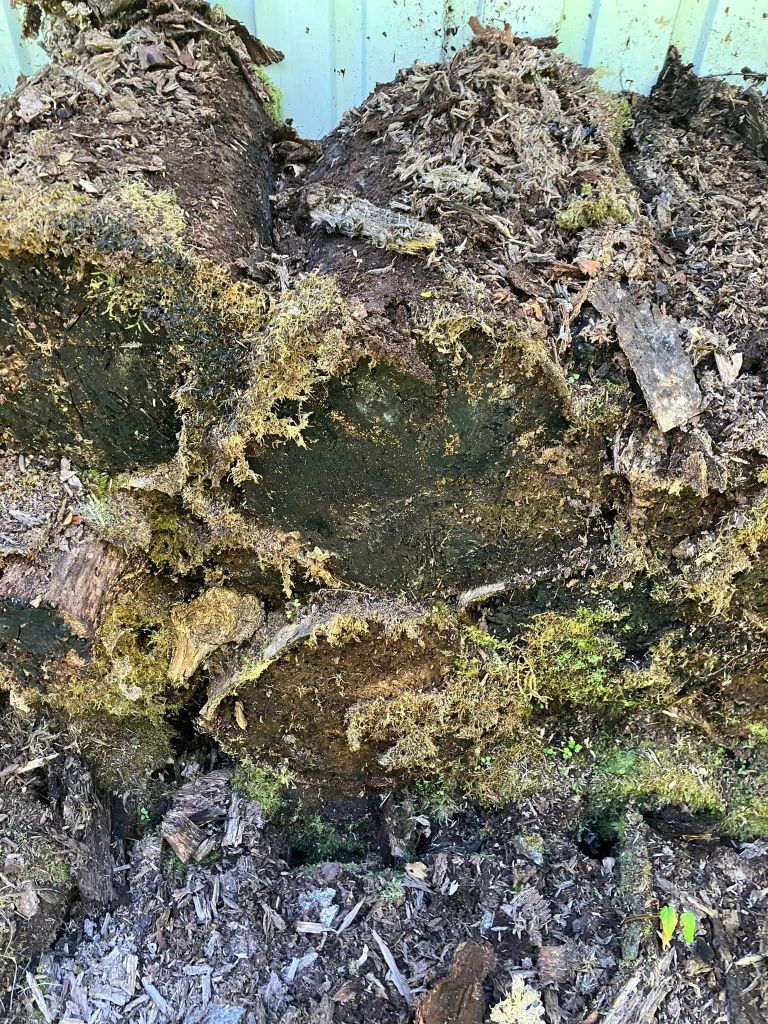
This wood crumbles easily in my hands. It’s on it’s way to becoming compost and it’s close by. I didn’t even have to walk into the woods. As it is, it’s going to waste. Probably not too healthy for the building it’s up against.

This for me is an incredibly easy source. I lucked out. It’s perfect for what I need it for. I can use some to fill the bottom of my raised beds, too, and the very crumbly broken down pieces I can sift and use as soil and in worm bins when I get them started. I could still haunt the woods for rotten pieces too, but for now I have plenty here for my needs.

And right now, that is mulching the fruit trees where I want to kill the vegetation around them. This will make it easier to plant the few daffodil bulbs I ordered for the fall as well as help feed the trees over time. I am using cardboard which I find makes a good smothering barrier and worm habitat under the mulch. The mulch keeps the cardboard hidden and looking nicer and holds it down from winds and keeps it from drying out. I may end up planting useful herbs around the trees eventually like pennyroyal and thyme but the dogs do come along and wee around the trees so I prefer to plant the edible herbs in a different location if you know what I mean.
This project is costing me zero dollars.
I am also starting the broccoli seedlings today. Looking online suggested that I plant 2-4 broccoli plants per person. There are 4 people full time on this property and one that is here a few times a month (they work a distance away) so I am counting them too. So I started 20 pods of seeds to transplant into the garden.
Now I did buy the seeds and the seed starting containers/pods. I could have done without buying the seed starting pods. I saw the containers on sale at work and had a weakness of will power. But I’m not ready yet to start things in the greenhouses, and it’s too hot in there anyway for tender seedlings that like it cooler. So I planted them in TINY on the table top and these containers take up less space then the containers I already had. I’m not perfect yet. I’m a recovering garden gadget-a-holic.
The cost was $13.58 for the containers and pods. The seeds the other day (organic) came to $2.80.
Other projects I’m working on today, a safe play area for my pup since he wants to run and antagonize the neighboring black labs every chance he gets. I’m trying to train that out of him but it’s taking awhile. I want him to be able to enjoy the outside, safely, when I can’t watch his every move when I’m busy. We both hate the tie out. So I pulled a bunch of T-posts this morning that were not being used and installed them around Tiny to make a yard. It’s not going to be pretty. I would rather do something nice like picket fencing, but I will be using what I have. And what I have is used T-posts and some rolls of fencing wire (both used and new) that I brought with me from the farm. I may have to purchase a few fasteners but the cost shouldn’t be bad. I will see if there are any laying around in the sheds.
 Climate Wary Homesteader