First off, I’m going to start off with a bit of a controversial topic. Often when I mention hybrid plants to the more misinformed crowd, there are always those who suddenly get up in arms, frantic that I’m about to make some horrible mistake. in which I try to kindly inform them then that hybrids are NOT GMO. Then I usually get one or two piping up with a “all hybrids are GMOs” and “GMOs have been around forever” comments.
And let me tell you, that isn’t true at all. It’s been an attempt to muddy the waters and confuse people for quite a few years now.
Hybrids can happen naturally. No lab needed. There are no strange non-vegetable inter-species breeding going on outside of the labs. Nature doesn’t work that way.
“But what about corn? It’s always been GMO! It wouldn’t exist otherwise!”
Again, wrong. Yes, there is gmo corn. But corn in its natural form was BRED AND SELECTED to be as it is until the recent introduction of GMO lab experiments that we now are all forced to eat and use.
There are still non-gmo corn out there, heirlooms that have been preserved and traditionally bred corns. You just have to grow it yourself and protect it from any neighbors pollen growing gmo corns.
GMOs happen in a laboratory. They insert genes that could never end up in a plant otherwise. Genes from animals, viruses, and bacterias and other species of plants for various reasons. One recent example is the glowing petunias.
In corn and other grains, it basically allows the farmer to dump herbicides on them (as in the case of round-up ready corn) or to try to poison pests that chew on them which ends up not working very well for very long as life finds a way.
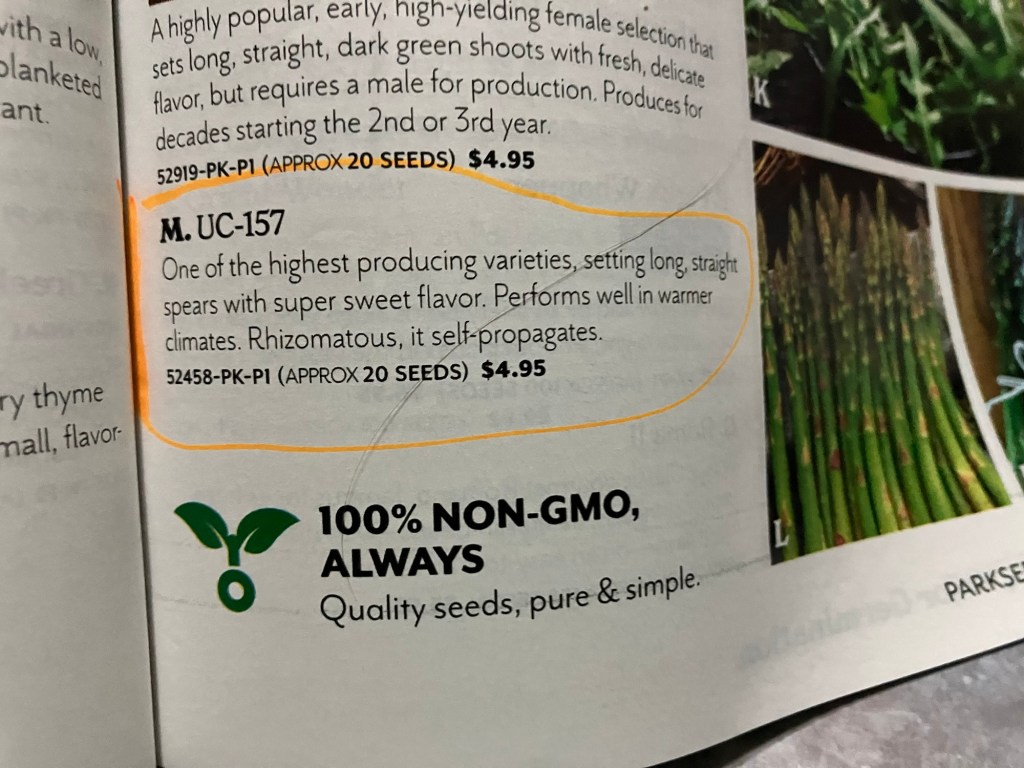
So why am I bringing this up? Because the new asparagus seeds, which are an F2 hybrid, will raise eyebrows in those folks who are clearly confused. Asparagus UC-157 F2 hybrid is not a gmo. It was conventionally bred. It likely took MANY years to do so. With meticulous notes, thinning out the unworthy, and encouraging the best traits. An F1 hybrid would take several years in itself to grow and assess. Then to breed that F1 hybrid with itself to become an F2 hybrid and again, with many years of assessing and seeing if the good results can be repeated enough times to make seeds the will become plants that have the traits desired. In this case, an asparagus that can clone itself with rhizomes rather than procreating just by seed.
Why am I excited about these seeds? If you’ve ever grown asparagus, and I have, in so many different gardens now, it takes a while to get to a decent sized harvest. Whether you start from purchased roots or seeds, it’s honestly about the same amount of time. Seeds are cheaper but you get so much variance in seed grown plants.
Imagine I plant these 25 seeds. If 15 of them grow, and I keep the most productive, I can easily expand the asparagus patch faster if they are spreading by roots. Cloned plants often produce faster as they already have developed roots. And you can be assured they will be the exact as the parent plant. No genetic variation. Which is a good thing if you want a long term perennial crop that produces for canning and preserving. Or if you are farming and selling. You can still propagate by seeds, of course, but in this case it’s not needed. And I like the thought of that in this particular case.
Does this mean I think we should all grow the same thing genetically? No, that’s asking for trouble like in the potato famines when there wasn’t enough variation in the crops. Most times I think it’s a good idea to have open pollinated crops in case of insects and diseases that may attack some and not others.
But for me? I’m just getting too old to keep trying to grow such a long term crop from the very beginning each and every time I have to move. At least with these, there is a good possibility I can take some with me when or if I ever have to move again.
 Climate Wary Homesteader